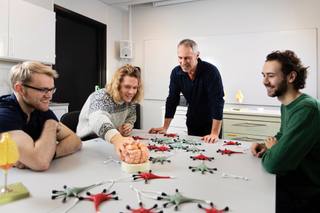
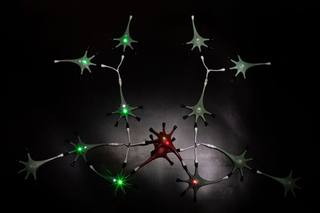
Associate professor Pål Kvello started this research project to give students a hands-on approach to learning about the brain—more specifically, its main building block, the neuron. The idea is to create a model neuron that can send and receive signals from other neurons. With many neurons, it becomes possible to reproduce the behaviour of simple networks found in biological brains.
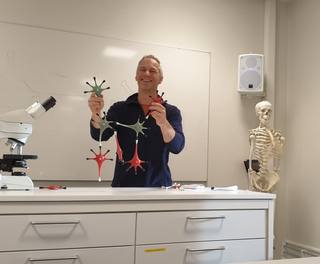
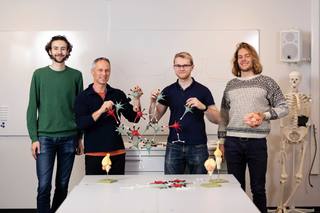
Pål Kvello holding a network of neurons.
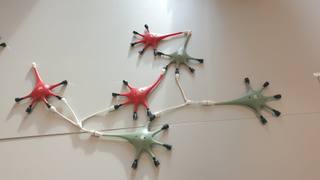
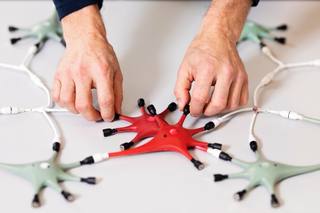
Starting point for our part of the project
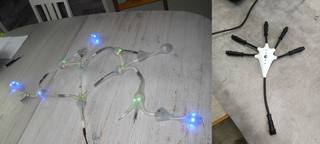
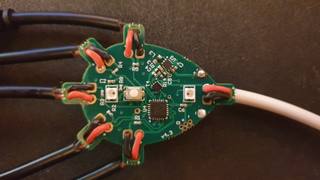
Version 2 (left) and version 3 (right).
The project was developed by students from scratch over four years. My partner, Inge Eide Johnsen, and I joined for its fourth generation. The neuron looked and worked much as it does now, but its cumbersome plugs made it frustrating to use. Our task was to solve that problem.
The solution seemed clear: magnetic plugs. The current version used ground, power, and data, but we could not find good magnetic plugs supporting three lines. Our task became combining power and data into two lines. We considered a battery, 1-Wire, a custom 1-Wire-like solution, and a variable-voltage supply. After complications, we ultimately settled on a battery solution.
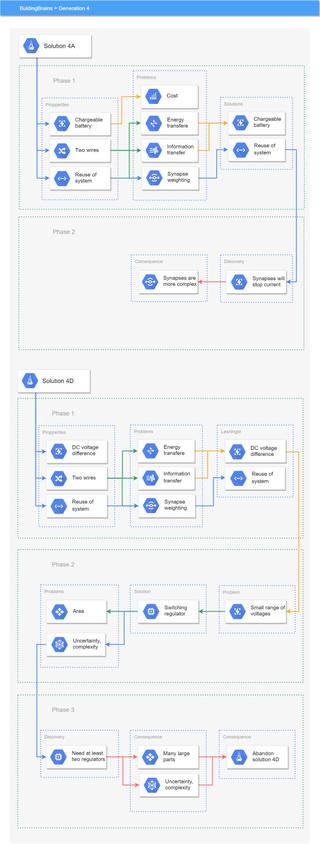
Interesting problems
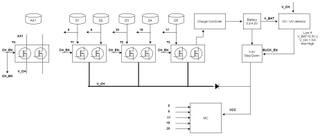
One difficult problem was receiving signals from five dendrites while keeping them isolated enough to receive several signals at once. We also needed to pass charging current through all dendrites and the axon. Diodes created too much voltage drop as networks grew, so we used microcontroller-controlled transistors instead.
Debugging preparation
Software brought a different set of problems. We did not use an interrupt-based system and, without experience implementing sleep modes, the neurons became power hungry. One especially useful investment was a debugging system that exposed variables through a serial connection to Python, where we could plot them in real time. It saved significant time later.
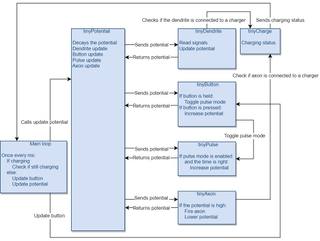
I came away appreciating debugging preparation. We often ordered PCBs to test circuit ideas, but investing the initial time to build and test the full circuit on a breadboard would have saved a lot of trouble. Assume problems will appear, and make them easy to find and fix.
Project photos
Photos taken for NTNU’s Department of Teacher Education by Elin Iversen/NTNU.